Project Director, Sonia Manchanda with her Dream Team counterpart, Raji.
Driven by Sonia,dream in initiative is an ttempt to move from dream to development rather from need.
Friday, January 14, 2011

Dream Posters
Dream Posters
Several individuals who made the first part of the project a great success!

Several individuals who made the first part of the project a great success!

José Carlos Teixeira@dream in
José Carlos Teixeira
Carlos Teixeira is an Assistant Professor and Director of Academic Affairs at the School of Design Strategies, at Parsons, The New School for Design, a pioneer in art and design education. He is also Dream Producer of the DREAM:IN Project.

Carlos Teixeira is an Assistant Professor and Director of Academic Affairs at the School of Design Strategies, at Parsons, The New School for Design, a pioneer in art and design education. He is also Dream Producer of the DREAM:IN Project.
@DREAM IN Project Prakash Unakal Dreamguru Discussions
http://www.dreamin.in/project.html
Dream : IN driven by Sonia Manchanda - Director (Idiom) is about
Dreams of every Indian will now become the only source of inspiration. For conceiving tomorrow’s big ideas for India, for sustaining development in the world’s most vibrant democracy.
India is ready. For growth. For personal growth as well as business growth. For transformation of yesterdays local enterprise into tomorrow’s big business. For opportunities like never before. There will be more people in cities higher incomes, more consumption, more ideas, more innovation.
India’s growth story will be created from the ambitions of its leaders, its CEOs, its visionaries. Ambitions that started from dreams. And dreams while being complex are strangely very simple and yet very big. Now is the time to dream.
The DREAM:IN project is the creation of a set of design thinkers across borders. It is designed to challenge us to create not for people’s needs, but for their dreams. Its time to get greed and need out of the way and create common dreams. In India, is it the time to unlock dreams, the dream of every common man, woman and child.
These dreams can then free us up and give us a bigger, grander canvas for new creation; for creating scenarios for a great equal future for our citizens and our country.
To realize these scenarios, we would need to create networks, networks where we build on each other’s ideas and create win – win situations.
Design thinking then will be our weapon to take ideas from mind to market, mind to reality with skill, speed and imagination.
Dream big for India, for its people, for ourselves. And create the environment, the networks, the detail, to realize them.
The DREAM:IN center will be an interactive theater, a reflection space where deep insights can come alive, a DREAM:IN studio, a hands – on creation space where future scenarios can be developed. A presentation place – where scenarios can be presented and collaboration possibilities can be discussed.
The prototype DREAM:IN center will be set up in the heart of Bangalore. This building will have a state of the art Design Thinking Studio. Subject matter specialists, sociologists, design thinkers and visionaries will use this space to come together to interpret dreams and develop future scenarios (ideas) for business and social change.
SPACE TO DREAM
The DREAM:IN center will have a state of the art studio and audio-visual facility that will enable dreamers to view, edit, upload and access dreams (both in our internal database as well as externally). The DREAM:IN center will be equipped to capture the dreams of anyone that is willing to dream.
TALENT TO CREATE
The talented team at Idiom will lend their expertise and provide hands on support to make ideas come alive in the various dream projects that will be underway.
NETWORKS TO REALIZE
The network that you see is actually much bigger and larger than you can imagine. With bodies like SPREAD, Idiom, Design Knowledge Network and NODES among others plugging into DREAM:IN, the number of people and organizations that this network will reach will be resources that will help you realize you’re dreams much faster and more efficiently than one could have ever thought possible.
Everyone has the right to dream and in India, there can be no better time than now, to begin to absorb and understand and to design ideas in the workshop of dreams. The DREAM:IN method and the DREAM:IN network will be accessible to everyone. And at DREAM:IN centers, dreams of various constituents will be unlocked
After the DREAM:IN conclave
The DREAM:IN projects will be spread across the country and will be closely monitored, reviewed by the Dreamproducers and Dreamcatalysts. The headquarters will be the DREAM:IN center in Bangalore.
A DREAM:IN report based on the DREAM:IN conclave will be prepared, published and widely distributed. This report will contain all the master data, including bio-sketches of all the participants, profiles of all the Dreamvestors, Dreamleaders, partners and organizations supporting DREAM:IN and information on the various projects that have been set up along with dreams and ideas that have the potential to become DREAM:IN projects themselves.
Dreams will be shared through the DREAM:IN portal. This portal will enable people across the country to view, access and upload their individual dreams. It will be simple and easy to use and the general public will be encouraged to use this DREAM:IN portal. The dreams captured will be fed directly in to the DREAM:IN database which will be accessible by Dreamvestors, Dreamleaders, partners, participants and the DREAM:IN society.
The prototype DREAM:IN center in Bangalore will be open to the various DREAM:IN teams that have taken up DREAM:IN projects. SPREAD and the DREAM:IN society will also help set up other permanent DREAM:IN centers within organisations, temporary centers for projects and even internationally, starting from Sri Lanka where a conversation has already begun.
Thursday, January 13, 2011
Powers of Ten: An adventure in magnitudes
Powers of Ten: An adventure in magnitudes
Powers of Ten is a 1968 American documentary short film written and directed by Ray and Charles Eames (Eames Office), rereleased in 1977. It is an adventure in magnitudes and remains truly stunning over 30 years later.
Thursday, January 6, 2011
Sunday, January 2, 2011
DREAM:IN Project Initiative
The DREAM:IN project is the creation of a set of design thinkers across borders. It is designed to challenge us to create not for people’s needs, but for their dreams. Its time to get greed and need out of the way and create common dreams. In India, is it the time to unlock dreams, the dream of every common man, woman and child.....
These dreams can then free us up and give us a bigger, grander canvas for new creation; for creating scenarios for a great equal future for our citizens and our country.
To realize these scenarios, we would need to create networks, networks where we build on each other’s ideas and create win – win situations.Design thinking then will be our weapon to take ideas from mind to market, mind to reality with skill, speed and imagination.
Dream big for India, for its people, for ourselves. And create the environment, the networks, the detail, to realize them.
Call for papers for the 4th World Conference on Design Research, organised by the IASDR (International Association of Societies of Design Research),
The theme of IASDR11 is DIVERSITY and UNITY.
The schedule and deadlines for submission and registration to IASDR 2011 are as follows:
* 04 February 2011: Deadline submission of proposals
* 21 March 2011: Notification of acceptance sent to authors
* 20 May 2011: Full paper submission
* 01 August 2011: Peer review results sent to authors
* 02 September 2011: Final paper uploaded
* 31 October 2011: Start conference
Proposals for papers or posters of no more than 800 words, as well as full papers will be subject to a double-blind reviewing process. Authors of accepted proposals will receive an invitation to submit a full paper or a poster.
Please see the conference website for more details: www.iasdr2011.org/
Friday, July 2, 2010
Thursday, January 28, 2010
The Design Ethos of Dieter Rams ,German Industrial Designer
German industrial designer, Dieter Rams has established himself as one of the most influential designers of the 20th century. His name has been strongly associated with the consumer products company Braun for which he had been working for over 40 years, and the Functionalist school of industrial design. Gestalten Books compiled Less and More a book which features images of hundreds of Rams’s products, his sketches and models while it elucidates his design philosophy. His elegantly clear visual language not only defined product design for decades, but also our fundamental understanding of what design is and what it can and should do.
Dieter Rams’ ten principles to “good design”
Good design is innovative
Good design makes a product useful
Good design is aesthetic
Good design helps us to understand a product
Good design is unobtrusive
Good design is honest
Good design is long-lasting
Good design is consequent to the last detail
Good design is concerned with the environment
Good design is as little design as possible
Wednesday, October 28, 2009
2nd place at India Innovation Initiative (i3) competition
Mr. Jagan Bastin; student of Product Design, MS Ramaiah School of Advance Studies, Bangalore Won 2nd PRIZE at nation-wide India Innovation Initiative (i3) competition of technology-based ideas conducted by Government of India (DST) and CII.
Mr. Jagan Bastin's Honey Extractor design which won accolades at the i3 competition was a project taken up as part of his final year M Sc (PD) program guided by Mr. Manas and Mr. Sudhindra Kumar.


Honey Extractor by Jagan Bastin
Ankur'09 October 24th

Ankur'09 Poster
ANKUR is an exhibition showcasing talented design works created by the newly joined product design and strategic product design management students of M S Ramaiah School of Advanced Studies, Bangalore.
On display in ANKUR’09 exhibition held on October 24th 2009 were...
Metal Art:
Innovative expressions were created from the metal scraps. These expressions were reflected in the form of sculptures using different metal compositions.
Bamboo Art:
Showcase of green materials to create objects of day to day use.
Tile Design:
Display of artistic tiles carved from plaster of paris.
Visual Work:
Sketches, Logo Design, and Digital renderings were displayed.
Ankur'09: - Student Works
Thursday, September 17, 2009
Design of Food Packaging Containers for Indian Railways
Labels:
food packaging,
railway
Total passengers travelling in trains everyday = 1,80,00,000 (18 million)
The above is total number of passengers which includes local trains, short distance and long distance.
Assume that 15% of travelers buy food in the train.
Thus no. of passenger buying food = 27,00,000 (2.7 million)
Thus approximately 3 million food packages are required everyday
And 3 million is quite a big number to cater..!!
There can be many solutions. Here is one.........
Designer: Parag Deshpande
Guide: Asst. Prof. Manas Ranjan Mishra
M S Ramaiah School of Advanced Studies.
There can be many solutions. Here is one.........
Designer: Parag Deshpande
Guide: Asst. Prof. Manas Ranjan Mishra
M S Ramaiah School of Advanced Studies.
Radical Design

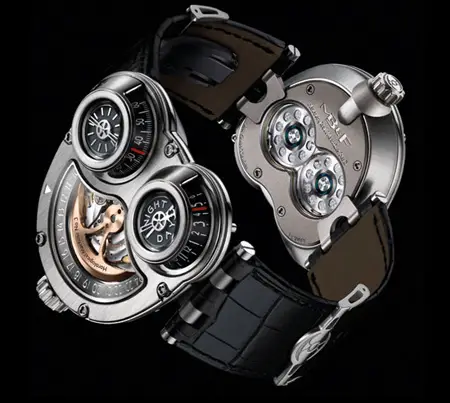
This good looker designed by Maximilian Busser & Friends is surely a collector’s item as has been designed especially for those who would like to own a masterpiece. The overall technology is based on Horological machines which tell time. The machine is designed and constructed in unlike the traditional wrist watches and hence are revolutionary. This version called as Horological Machine No.3 has been introduced in two versions : “Sidewinder”, with its cones perpendicular to the arm; and “Starcruiser”, with its cones in-line with the arm. Each has its own very distinct visual characteristics; each offers its own unique angle on telling the time.
[Source: http://www.tuvie.com/horological-machine-no-3-radical-watch-design-by-maximillian-busser-and-friends/]
Tuesday, September 1, 2009
Three ways that makes a good design happy - Don Norman
Good products gets appreciation is not just because it is good at Design but the type of link that it actually bridges more than its style, look or by function
Don Norman turns his incisive eye toward beauty, fun, pleasure and emotion, as he looks at design that makes people happy
posted by
Karthik TD
Wednesday, August 26, 2009
QLOCKTWO
Labels:
Industrial Design,
Lohit HS

Image Ref.: http://www.qlocktwo.com
QLOCKTWO Clock by Biegert & Funk, Germany tells the time in a unique fashion. QLOCKTWO spells time !!! The award winning QLOCKTWO is available in five different languages and five different colors. It comes loaded with other features like automatic summer/winter daylight-savings time, automatic adjustment to ambient light, manual brightness control, low energy consumption due to LED technology, etc.
For more info, visit http://www.qlocktwo.com
Posted by Lohit HS
For more info, visit http://www.qlocktwo.com
Posted by Lohit HS
Thursday, August 20, 2009
Design process
Labels:
Design process
Different organizations have adapted their own style of innovating products.
Key Milestones in design process are :
- Know Your Audience
- Analyze User Tasks
- Build Prototypes
- Observe Users
- Guidelines for Conducting User Observations
- Making Design Decisions
When making design decisions regarding features in your application, it’s important to weigh the costs, not all of which are financial, against the potential benefits. Every time you add a feature to your application, the following things can happen:
• Your application gets larger.
• Your application gets slower.
• Your application’s human interface becomes more complex.
• You spend time developing new features rather than refining existing features.
• Your application’s documentation and help become more extensive.
• You run the risk of introducing changes that could adversely affect existing features.
• You increase the time required to validate the behavior of your application.
Choosing appropriate features and devoting the needed resources to implement them correctly can save you time and effort later. Choosing poor feature sets or failing to assign appropriate design, engineering, testing, and documentation resources often incurs heavier costs later when critical bugs appear or users can’t figure out how to use your product.
The following sections present several additional factors to take into consideration before adding features to your product.
Avoid Feature Cascade
Apply the 80 Percent Solution....read more on following links...
http://developer.apple.com/documentation/userexperience/Conceptual/AppleHIGuidelines/XHIGDesignProcess/XHIGDesignProcess.html#//apple_ref/doc/uid/TP40002718-TPXREF114
posted by
Karthik TD
Tuesday, August 11, 2009
World is your Pallette : MIT's IO Brush
MIT's "I/O Brush", allows you to paint using the world as your pallette,excellent innovation...take a look at the video below :
Water can
The thirst of drinking filtered water brings the design of lager water cans. The weight and the shape of the can create problems in lifting and fixing the same to the dispenser. The thicker plastic seal is temper proof upto certain level, but its not so easy to remove. Here is a proposed solution for the larger water cans.
Design by: Mr Madana Gopal
Guided by: Asst Prof Manas Ranjan Mishra
Thursday, July 30, 2009
The Bus conductor - A innovative solution
Many of us travel in bus, but how many times we see the pain of the bus conductor. Collecting money in a crowded Indian city bus is tiring. Mr. Murli from Bangalore, had traveled in BMTC buses. He got his own opinion about the discomfort of BMTC bus conductors. He had also propose one possible solution. Please have a look.. comments are encouraged.
Subscribe to:
Posts (Atom)

